I learned to crochet a year or two before my accident, using beginner crochet kits from the Woobles and eventually progressing to larger projects. It became a good way for me to relax while doing something with my hands, and became part of my evening ritual while watching TV or chatting with my husband.
After my accident, I was so bored. I was out of work on short-term disability and didn’t have the physical ability to do much beyond watching TV or listening to audiobooks. Between my broken fingers on my right hand and my amputated left hand, even holding a physical book was out of reach.
During this time, I realized I would need to find ways to reclaim my hobbies as I progressed further in my healing journey. Crocheting was one of the first items on my list to relearn.
How to Crochet with One Hand
Through some extensive Googling, I found some suggestions and tutorials about knitting or crocheting with one hand. Most of them essentially boil down to finding a way to “hold” your hook (or needle) in a fixed position and using your hand to manipulate the yarn around it.
There are several ways you can go about this:
- Clamp your crochet hook to the back of a chair or the edge of a table.
- Create a custom tabletop crochet aid. Helen Zhou has a tutorial available on YouTube.
- “Hold” the hook with your injured/shorter limb.
- I use Tunisian crochet hooks because the length allows me to pin the hook against my body with my elbow. For added security, I’ll also tuck the hook down the sleeve of my shirt and loosely attach it to my arm with a velcro strap.
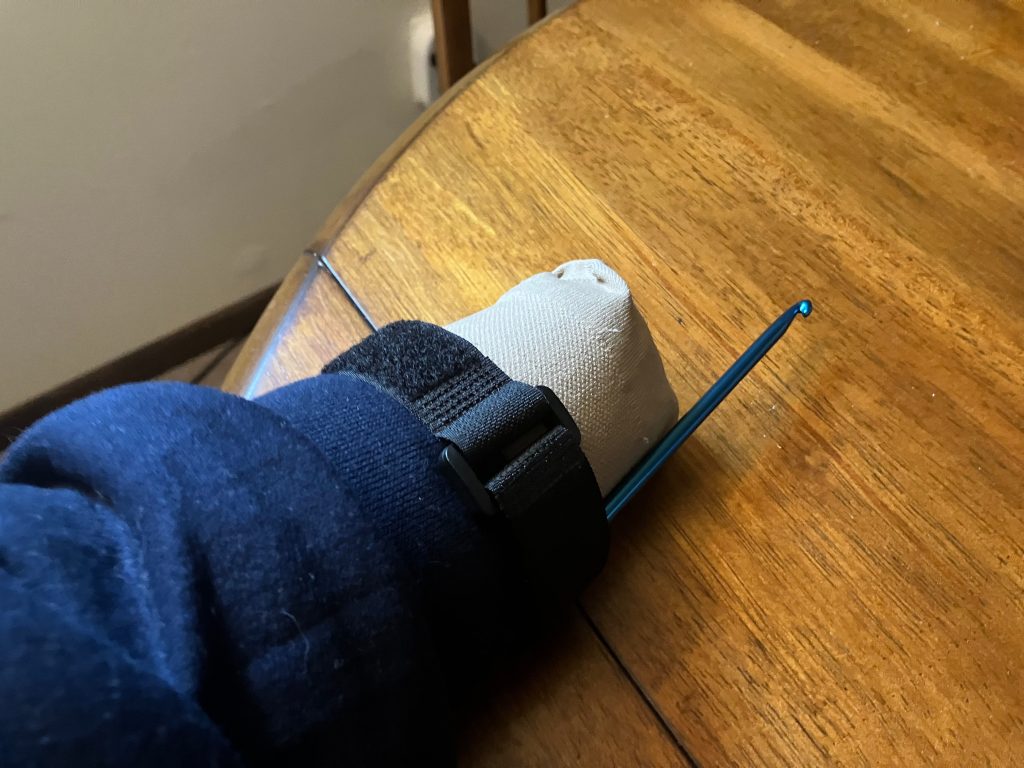
Helpful “Adaptive” Crochet Tools
Admittedly, I’m using the term adaptive loosely here. Most of these tools are not designed to be adaptive, but I’ve found them helpful as I’ve relearned to crochet.
Tunisian Crochet Hooks
The added length on these hooks make them easier to work with and control. Though designed specifically for Tunisian crochet, I haven’t run into any issues using them on other types of projects.
Velcro Straps
Look for velcro cinch straps like the kind for organizing cables. I find that the 12 inch ones are about the perfect length for securing the hook to my forearm. Be careful not to cinch it too tight!
Yarn Bowl/Ball Winder
One of the aspects of crochet that I still struggle with is untangling knots in my yarn. Keeping my balls of yarn neatly wound and stored helps prevent big tangles.
Needle Threaders
Needle threaders help make it easier to thread your yarn tails into a darning needle and weave in your ends. If I don’t have a needle threader, I’ll pin the needle against the edge of a table with my left forearm while threading it with my right hand.
Reading/Nursing Pillow
I like using a pillow to support my left arm while I crochet to prevent fatigue and tension in my arm and shoulder from holding the hook in the correct position.
Have other tips or ideas? Let me know!

 Navigating Upper Extremity Amputation
Leave a comment